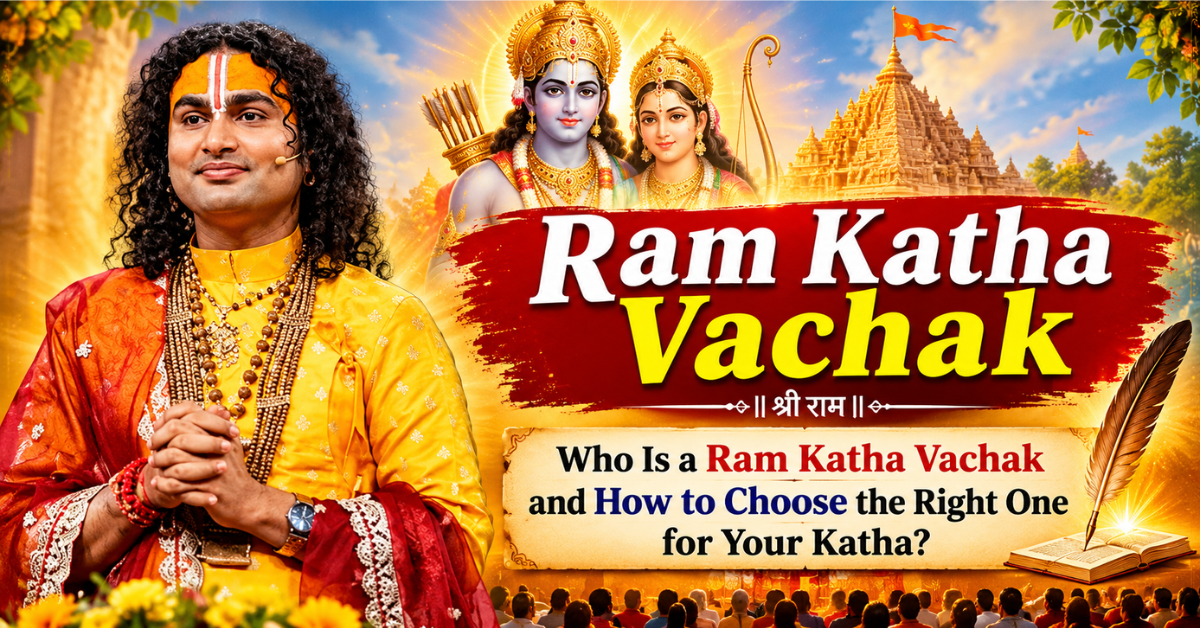
Ram Katha Vachak: Who Is a Ram Katha Vachak and How to Choose the Right One for Your Katha
When a family decides to organise a Ram katha, the first and most important decision is the choice of the speaker. The right Ram katha vachak can turn a few days of listening into a memory that lasts for generations. The wrong choice can leave the audience restless and the message unclear. This guide explains who a Ram katha vachak is, what qualities to look for, how a Ram katha is usually structured and what you should ask before you book.
If you want to see how a modern katha vachak presents the Ramayana, you can visit our dedicated Ram katha vachak page on the official website.
Who Is a Ram Katha Vachak?
The word vachak comes from the Sanskrit root meaning to speak. A katha vachak is therefore a spiritual narrator, a person who recites and explains sacred stories in front of an audience. A Ram katha vachak specialises in the story of Shri Ram as told in the Valmiki Ramayana, the Ramcharitmanas of Goswami Tulsidas and other regional versions of the epic.
The role is not that of an entertainer. A good vachak is part scholar, part singer, part teacher and part guide. The vachak must know the text, explain it with clarity, sing the bhajans with feeling and, above all, live in a manner that reflects the values being taught. Listeners instinctively trust a speaker whose life matches his words.
The Tradition Behind Ram Katha
Ram katha has been told in India for thousands of years. The Valmiki Ramayana, composed in Sanskrit, is regarded as the first poetic telling of the story. Centuries later, Tulsidas wrote the Ramcharitmanas in Awadhi, a language common people could understand, and it became a part of daily devotion in many households. Regional versions in Tamil, Bengali, Telugu, Kannada, Odia and many other languages show how deeply the story has entered Indian culture.
Over time, the tradition of oral exposition grew alongside the written texts. In villages and temples, vachaks gathered people in the evenings and explained the story verse by verse. This tradition is still alive today, and it has expanded to television, online streaming and large international gatherings. Yet the heart of the event has not changed. A speaker sits before listeners and tells the story of Ram with love.
What Happens in a Ram Katha
A traditional Ram katha may be organised over seven or nine days, though shorter versions of one to three days are also common. Each day follows a broad outline and covers a different part of the story.
- Ram janm and childhood. The birth of Ram, Bharat, Lakshman and Shatrughan in Ayodhya, and the early teachings of Guru Vashishtha and Vishwamitra.
- Sita swayamvar and marriage. The breaking of Shiv's bow and the sacred union of Ram and Sita.
- Vanvas. The exile of fourteen years, Kaikeyi's boons, Dasharath's grief and Bharat's deep love for his brother.
- Sita haran and the search. The abduction of Sita, the meeting with Hanuman and Sugriv, and the friendship that changes the course of the story.
- Lanka kand. The crossing of the ocean, the battle with Ravan and the victory of dharma.
- Ram rajya. The return to Ayodhya and the ideal kingdom that remains a dream of good governance even today.
Between these episodes, the vachak sings bhajans, tells related stories and answers the question that matters most to the audience, namely what the story means for their own lives. Many katha programmes close with a havan, aarti and prasad distribution.
Qualities of a Good Ram Katha Vachak
Not every speaker suits every audience, but the following qualities are widely recognised as signs of a good Ram katha vachak.
- Deep knowledge of the scriptures. The vachak should be comfortable with the Valmiki Ramayana and the Ramcharitmanas, and able to quote and explain verses accurately.
- Simple and clear language. The best explanations are those that a child and a grandparent can both follow.
- Melodious voice and bhajan skills. Music is a large part of Ram katha, and good singing lifts the entire mood of the gathering.
- Practical wisdom. The ability to link the story with family life, work, relationships and mental peace.
- Humility and discipline. A good vachak respects other traditions, avoids unnecessary controversy and focuses on devotion.
- Respect for time and organisers. A well run programme starts on time, follows the agreed schedule and cooperates with the host family.
When these qualities come together, the audience feels connected rather than lectured. People remember the message long after the programme ends.
The Ram Katha Vachak and the Modern Listener
Today the audience of a Ram katha is very different from what it was a century ago. Many listeners are young professionals who work long hours and live far from their hometowns. Others are children growing up abroad who have never heard the story in this form. A modern vachak must therefore speak in a way that respects the tradition yet remains relevant, using examples from present-day life without losing the dignity of the text.
This is one reason online access has become important. Families who cannot attend in person can still watch recordings, read teachings and stay connected. If you want to see how these teachings are presented, you can browse the main website of Aniruddhacharya Ji Maharaj , where katha related information is shared with devotees.
Life Lessons Every Ram Katha Vachak Highlights
Whoever the speaker is, certain teachings appear again and again in a Ram katha because they lie at the heart of the epic.
The first is maryada , the idea of living within limits of duty and dignity. Ram accepts exile without complaint because he honours his father's word. The second is sacrifice , seen in Lakshman, Bharat and Sita, each of whom gives up comfort for the sake of love and duty. The third is loyalty and friendship , seen in Hanuman, Sugriv, Vibhishan and even the humble boatman Kevat and the devoted Shabari. The fourth is the triumph of truth , since Ravan, despite his power and learning, falls because of ego and wrongdoing.
A listener who absorbs even one of these lessons has gained something valuable. This is the real purpose of hearing Ram katha, and it is why a good vachak always spends more time on meaning than on spectacle.
How to Choose the Right Ram Katha Vachak for Your Event
Before you book, consider the following points carefully.
- Purpose of the katha. Are you organising it for a festival, a family celebration, a memorial or a community event? Different occasions suit different formats.
- Duration and schedule. Decide whether you need a one day katha or a full seven or nine day programme, and confirm the daily timings.
- Language. Make sure the vachak speaks in a language your audience understands comfortably.
- Venue and audience size. Large gatherings need good sound arrangements, shade or air conditioning, seating and crowd management.
- Reputation and references. Ask other families who have organised a katha with the same vachak and watch a few recordings to understand the style.
- Clarity on arrangements. Confirm travel, stay, team size and other requirements in advance so that there are no misunderstandings later.
You can find more guidance and contact information on the Ram katha vachak page. It is also worth exploring related forms of katha. For example, families often follow a Ram katha with a Hanuman katha because the two are so closely linked, and many also organise a Satyanarayan katha at home to complete their celebrations.
Preparing Your Family and Community
A katha is a shared event, so preparation matters. Invite relatives and friends early and encourage children to attend at least a few sessions. Create a simple, clean space with a picture of Shri Ram, Sita, Lakshman and Hanuman. Keep the environment free from loud distractions, and remind guests to switch off their phones during the recitation.
It also helps to read a little before the katha begins. Even a short summary of the Ramayana prepares listeners to follow the story with understanding. Afterwards, discuss what you heard with your family, because conversation turns listening into learning.
Conclusion
A Ram katha vachak is a bridge between an ancient scripture and a modern household. The best vachaks combine knowledge, music, humility and warmth, and they leave their audience feeling calmer, kinder and clearer about their duties. If you are planning a katha, take time to choose the right speaker, prepare your family and approach the event with a sincere heart.
To learn more, visit the Ram katha vachak page and explore the teachings available there. May the story of Shri Ram bring peace, harmony and strength to your home. Jai Siya Ram.
Share this post:
Continue Your Spiritual Journey
Explore related kathas and pujas for devotion, family occasions, and deeper spiritual practice.
Table of Contents
- Ram Katha Vachak: Who Is a Ram Katha Vachak and How to Choose the Right One for Your Katha
- Who Is a Ram Katha Vachak?
- The Tradition Behind Ram Katha
- What Happens in a Ram Katha
- Qualities of a Good Ram Katha Vachak
- The Ram Katha Vachak and the Modern Listener
- Life Lessons Every Ram Katha Vachak Highlights
- How to Choose the Right Ram Katha Vachak for Your Event
- Preparing Your Family and Community
- Conclusion