

Top Katha Vachaks in India: Bhagwat, Hanuman, Ram, and Satyanarayan Katha Experts
India holds one of the oldest living oral traditions in the world. For centuries, scripture reached ordinary households not through books but through the voice of a katha vachak — a trained narrator seated on the vyas peeth, reciting and explaining the shastra to whoever gathered to listen.
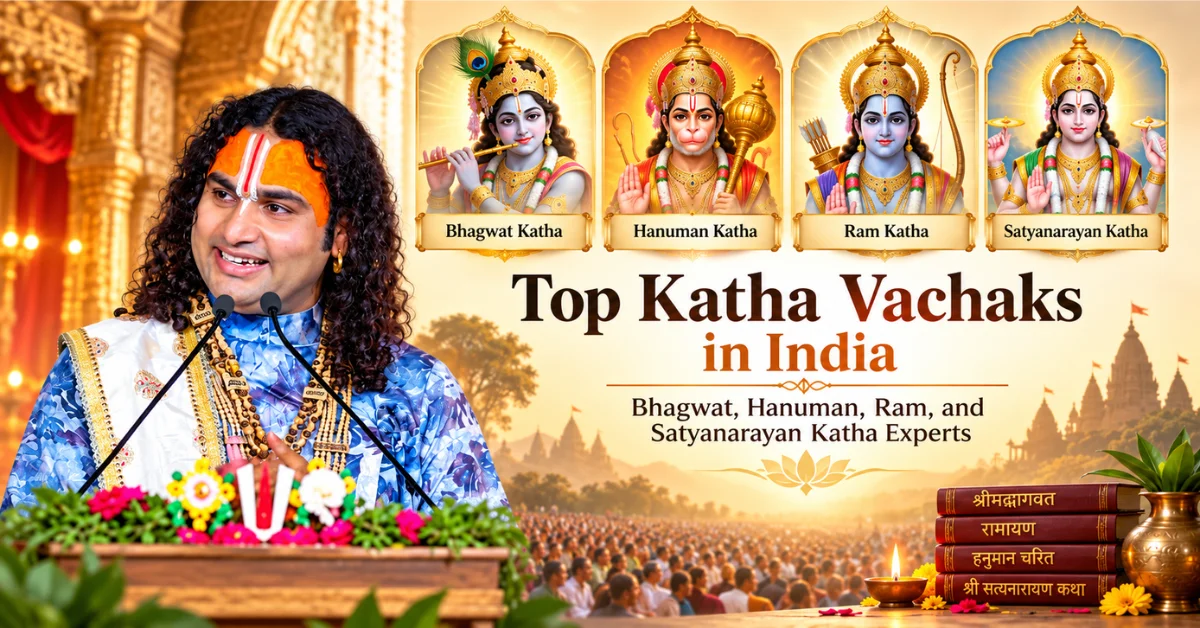
That tradition has not faded. It has moved. Narrations that once reached a few hundred people in a village courtyard now reach lakhs through YouTube and devotional television, and India's leading narrators travel to Australia, Canada, the United States, the United Kingdom and the Gulf as routinely as they move between Indian states. Over the past few years the diaspora booking window has tightened sharply — festival dates in overseas cities are now reserved months in advance rather than weeks.
But "top katha vachak" is not a single title. It is four different skill sets, drawn from four different scriptures, and a narrator who is outstanding at one is not automatically outstanding at another. This guide explains what separates the best in each, and how to judge one for yourself before you commit a date.
What "Top" Actually Means in This Field
There is no certifying body, no licence and no public register. Anyone can place a chair on a stage and call it a vyas peeth. So the word "top" has to be defined by something more reliable than crowd size or follower count.
Across India, the narrators who are genuinely held in high regard share five traits:
- Guru parampara. They studied under a named teacher in a recognised lineage, and will tell you which one if you ask.
- Textual command. They recite from the original and can cite exactly which canto, kand or chapter a passage belongs to.
- Complete vidhi. The ritual sequence around the narration is performed properly, not compressed to fit a schedule.
- Consistency off the stage. What they do when they are not narrating — ashram work, gaushala, annakshetra, gurukul — is visible and verifiable.
- They finish what they start. The same narrator stays for every day of the programme.
Judge any name against those five and the list shortens very quickly.
Bhagwat Katha Experts
The Shrimad Bhagavata Purana is the most demanding of the four. Twelve skandhas, traditionally narrated across seven days as a saptah, running in a fixed order from King Parikshit through Krishna's janm and leelas to Sudama charitra and the closing havan.
What separates the best
A leading Bhagwat narrator keeps the sequence. The common shortcut in this field is to open with Krishna janm and Maharaas because those draw the strongest response, then fill the remaining days loosely. A trained narrator will tell you in advance exactly what each day covers, and the kalash yatra, vyas peeth puja and purnahuti will all be performed in full.
Ask which skandha a particular prasang belongs to. Genuine study answers that instantly; a memorised repertoire does not. Families planning a full seven-day saptah should settle this question before anything else.
Ram Katha Experts
Here the test is completely different. Ram Katha is narrated from Goswami Tulsidas's Ramcharitmanas, and the measure of a top narrator is whether the chaupais are recited accurately from memory and their meaning genuinely explained — not paraphrased loosely around the storyline.
The passages that reveal skill
Kaikeyi's boon. Bharat's refusal of the throne. The Uttar Kand. These are the uncomfortable sections, and they are where a Ram Katha either teaches something or quietly skips ahead to keep the mood light.
The finest narrators in this tradition slow down precisely where the story becomes difficult, because the subject of Ram Katha is not what Shri Ram did — it is the boundaries he refused to cross while doing it. A programme covering all seven kands in sequence is the format in which that teaching actually lands.
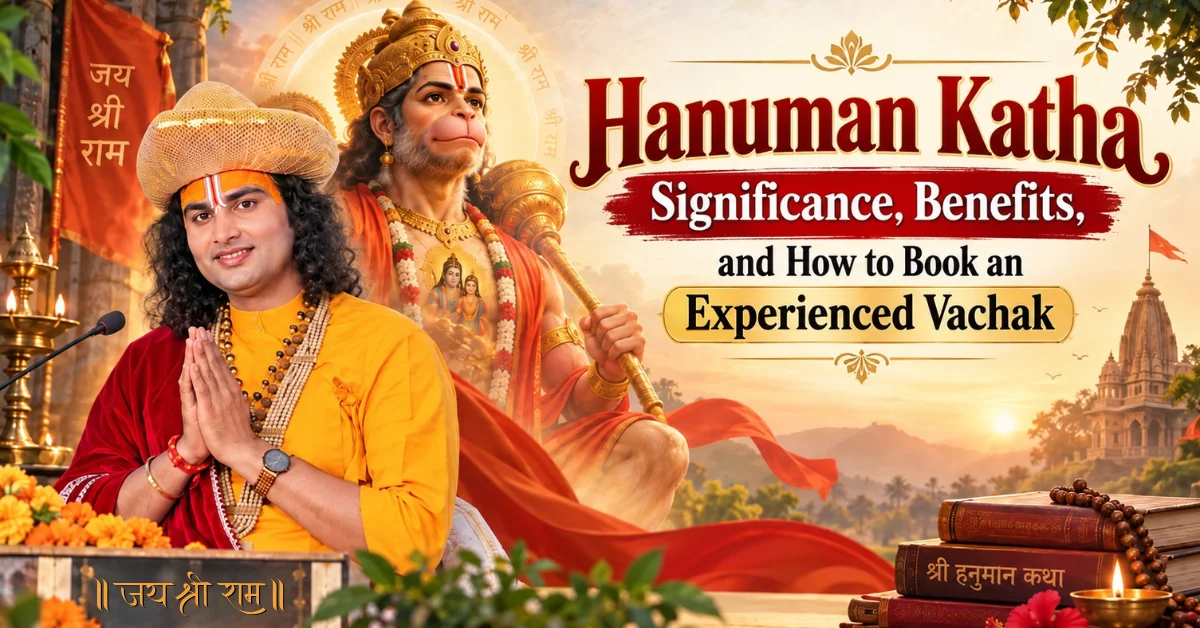
Hanuman Katha and Sundarkand Experts
The particular skill here is leading rather than addressing. A Hanuman Katha lives on collective recitation — the whole hall singing the Sundarkand and the Hanuman Chalisa together, not sitting silently while one person performs.
Why Sundarkand is the benchmark
Sundarkand is the fifth kand of the Ramcharitmanas and the only section where Hanuman Ji, not Shri Ram, is the central figure. It is also, from beginning to end, a chapter of accomplishment — every task undertaken in it succeeds.
A narrator who carries a sangat into that recitation, and who covers the full arc from the janm katha onward rather than jumping to Lanka dahan for the drama, is working at the top of this tradition. This is also the most accessible format for a first-time host, since a Sundarkand path fits comfortably into a single Tuesday or Saturday evening.
Satyanarayan Katha Experts
This one looks the simplest, which is exactly why it is most often performed carelessly.
The step most people never notice
The full vidhi runs sankalp, Ganesh puja, navagraha puja, kalash sthapana, sthapana of Bhagwan Satyanarayan — and only then the katha. A narrator who begins directly with the stories has skipped the puja entirely.
Equally, all five adhyayas must be recited. Shortening to two or three defeats the purpose, because the fourth and fifth carry the central teaching: honour a promise once made, and never treat prasad casually. A properly conducted single-sitting home puja ends only when the prasad has reached every person present.
Pujya Shri Aniruddhacharya Ji Maharaj
Among the narrators working across all four of these traditions is Pujya Shri Aniruddhacharya Ji Maharaj, founder of Shri Gauri Gopal Ashram in Vrindavan.
He conducts Shrimad Bhagwat Katha, Ram Katha, Hanuman Katha with Sundarkand path, and Satyanarayan Katha, and his discourses reach devotees worldwide through the Gauri Gopal TV channel. What gives the fifth trait above its substance in his case is the institution behind the name — the ashram's ongoing seva runs a gaushala for cow service, an old age home for abandoned elders, an annakshetra serving daily meals, and a gurukul for children's Vedic education.
For host families overseas, that matters in a practical way too: his work from Vrindavan includes regular programmes for temples, associations and private yajman families across Australia and Canada.
How to Verify Any Narrator Before You Book
Seven questions settle it, and they take one phone call:
Which guru parampara did you train in?
What exactly will be covered in each session?
Does your team perform the puja vidhi, or do we arrange a pandit separately?
Will the same narrator be present for every day?
When will we receive the samagri list?
What are the travel and accommodation requirements?
Can we speak to a family who hosted your programme previously?
Matching the Narrator to Your Occasion
| Your occasion | The right programme | Typical duration |
|---|---|---|
| Griha pravesh, new business, thanksgiving | Satyanarayan Katha | One afternoon |
| Obstacles, exams, a family sankalp | Hanuman Katha with Sundarkand | One evening |
| Ram Navami, Diwali, a community gathering | Ram Katha | 3 to 9 days |
| Janmashtami, a major family observance | Bhagwat Saptah | 7 days |
Be honest about your volunteer strength before choosing. A short programme hosted well serves a family far better than a long one hosted thinly.
Share this post:
Frequently Asked Questions
Continue Your Spiritual Journey
Explore related kathas and pujas for devotion, family occasions, and deeper spiritual practice.
Table of Contents
- Top Katha Vachaks in India: Bhagwat, Hanuman, Ram, and Satyanarayan Katha Experts
- What "Top" Actually Means in This Field
- Bhagwat Katha Experts
- What separates the best
- Ram Katha Experts
- The passages that reveal skill
- Hanuman Katha and Sundarkand Experts
- Why Sundarkand is the benchmark
- Satyanarayan Katha Experts
- The step most people never notice
- Pujya Shri Aniruddhacharya Ji Maharaj
- How to Verify Any Narrator Before You Book
- Matching the Narrator to Your Occasion
.webp)