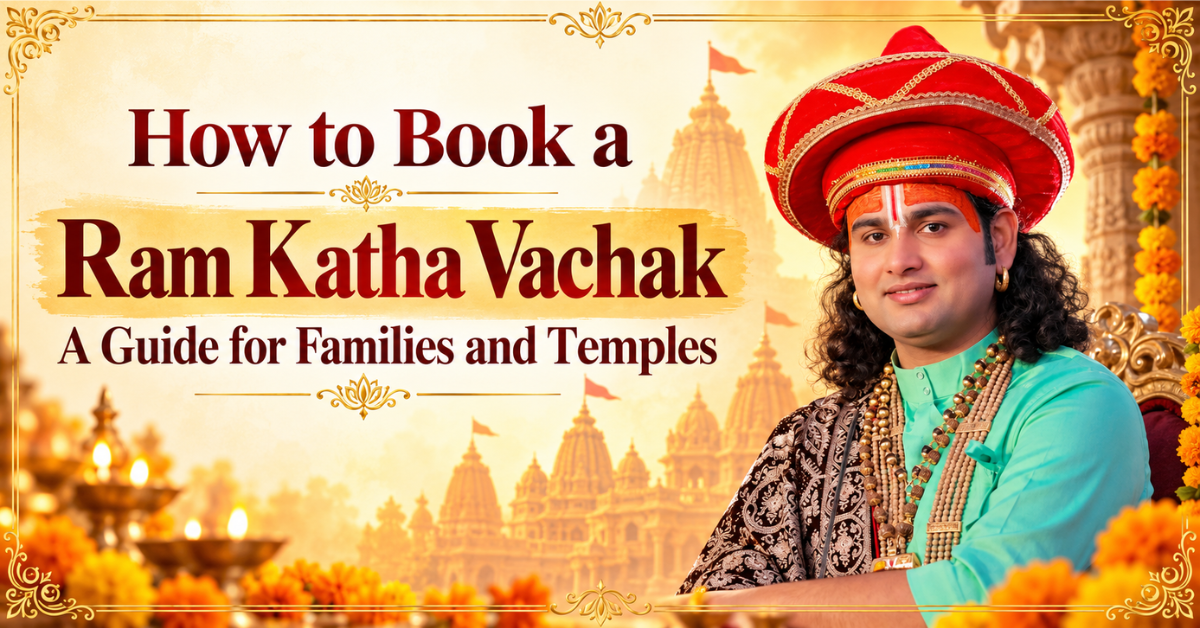
How to Book a Ram Katha Vachak: A Guide for Families and Temples
Booking a Ram Katha vachak follows five steps: choose your duration, fix the venue and date together, confirm the narrator's availability, agree who arranges what, and prepare the venue from the samagri list you are sent. Four to eight weeks of notice is comfortable for most dates, and three to six months for Ram Navami and Diwali-season programmes.
What follows covers the booking itself, the questions worth asking, and how the arrangements differ between a family programme and a temple one.
What You Are Booking
A Ram Katha vachak is a trained narrator who recites the chaupais of Goswami Tulsidas's Ramcharitmanas from the vyas peeth and explains their meaning to the assembled sangat, alongside bhajans, daily aarti and the ritual sequence that frames the narration.
A full Ramkatha follows the seven kands in order — Bal Kand through Uttar Kand — and a seven-day programme covers roughly one kand per day. Formats and durations are listed on the Ram Katha service page .
Choose the Duration First
Everything else follows from this decision.
| Format | Who it suits | What it covers |
|---|---|---|
| Single session | Home programme, an evening gathering | Key prasangs, bhajan, aarti |
| Akhand Ramayan path | A 24-hour continuous recitation | The full Ramcharitmanas, closing with havan |
| 3-day katha | Weekend family or community event | Condensed arc from Ayodhya to the return |
| 5-day katha | Mid-size temple or association programme | Most kands with daily bhajan sessions |
| 7-day katha | The most commonly hosted community format | All seven kands in sequence |
| 9-day katha | Ram Navami mahotsav, large trust event | Extended narration with utsav days |
Be realistic about volunteer strength rather than budget. A three-day programme run well leaves a better impression than a nine-day one run thinly.
Families and Temples Book Differently
For a family programme
A single session or three-day katha at home suits a griha pravesh, a wedding anniversary, a barsi or a family sankalp. You need a room that can hold the vyas peeth and your guests, a Ram Darbar murti or framed picture, and seating. Notice of three to four weeks is usually enough.
For a temple or association programme
A seven or nine-day katha for a mandir or community group needs the venue fixed before the narrator's date — not after. You will also need a stage, tested sound, a volunteer team across registration, seating, prasad and cleanliness, and a sponsor structure agreed in advance.
Committees usually share costs across several sponsor families, which keeps the programme affordable and almost always produces better attendance.
The Booking Process
Send your details. City, two or three possible date windows, chosen duration, venue type and expected attendance.
Confirm availability. The team checks the calendar and suggests the nearest workable window if your first choice is taken.
Plan the programme. Finalise the daily schedule, the kalash yatra, aarti timings and the havan day.
Prepare the venue. You receive the samagri list, vyas peeth and stage guidance, and the sound requirements.
Host the katha. The narrator and team arrive ahead of day one, and the programme opens with the kalash yatra.
Questions Worth Asking
Which guru parampara did you train in?
A trained vachak names his lineage without hesitation.
Are the chaupais recited from the original?
They should be, with the meaning explained rather than the storyline simply paraphrased around them.
Will the difficult prasangs be covered?
Kaikeyi's boon, Bharat's refusal of the throne, the Uttar Kand. These are where a Ram Katha either teaches something or quietly moves on to keep the mood light. Ask directly.
What will each day cover?
You should receive a kand-by-kand outline before confirming.
Does your team perform the puja vidhi, or do we arrange a pandit?
Settle this early; it causes the most last-minute confusion.
Will the same narrator be present every day?
Substitutions midway break the continuity a katha depends on.
Can we speak to a family or committee who hosted you before?
The most useful question on the list.
What Each Side Arranges
Provided by the vachak's side
Narration for the agreed days, the vyas peeth puja and daily ritual sequence performed by the accompanying team, bhajan and kirtan support, guidance on the samagri list and kalash yatra route, coordination on timings and the concluding havan, and pre-programme calls with your committee.
Arranged by the host
The venue with permissions where required, stage and vyas peeth with a Ram Darbar murti or framed picture, tested sound with a lapel mic, puja samagri, travel and sattvic vegetarian accommodation for the narrator and team, daily prasad and the closing bhandara, and volunteers.
Ram Katha samagri
A Ram Darbar murti or picture, kalash and coconut, mango leaves, red and yellow cloth, roli, chandan, akshat, moli, haldi, supari, panchmeva, gangajal, tulsi dal, flowers and garlands, incense and dhoop, ghee and wicks for the akhand deep, panchamrit ingredients, havan samagri and samidha, and a Ramcharitmanas pothi.
Niyam for the yajman family
Take the sankalp on day one before the vyas peeth puja. Keep a sattvic vegetarian kitchen for the duration — no onion, garlic, alcohol or tamasic food. Keep the akhand deep lit before the Ram Darbar where the tradition is followed. Bathe and wear clean clothes before each session. Sit through each session to its aarti. Serve prasad daily with humility.
What It Costs
Katha is offered as seva, so there is no price list and no fixed fee. What a host budgets for:
| Item | Arranged by |
|---|---|
| Travel, local and international | Host |
| Accommodation and sattvic meals | Host |
| Venue hire | Host |
| Stage, vyas peeth, sound | Host |
| Puja samagri | Host |
| Daily prasad and closing bhandara | Host |
| Dakshina | Offered by the yajman as per tradition and capacity |
Timing Your Programme
These windows are traditionally preferred, and they fill earliest:
- Ram Navami and Chaitra Navratri — the most sought-after dates of the year.
- Vivah Panchami — observed as the Ram–Sita vivah day.
- Kartik Maas and the Diwali period — marking the return to Ayodhya.
- Shravan Maas and Chaturmas generally.
- Shraddh Paksha — for kathas offered in memory of ancestors.
For overseas programmes, long weekends and school-holiday periods matter as much as the panchang, because attendance depends on when the community can actually gather. Tours are planned as multi-city routes, so early enquiry improves the chance your city fits the itinerary.
Combining Programmes
Committees frequently arrange more than one katha during a single visit. An evening Sundarkand path pairs naturally with a Ram Katha, since Sundar Kand sits at the centre of both. Groups planning a longer programme the following year often book a seven-day Bhagwat saptah while the committee is already assembled.
Pujya Shri Aniruddhacharya Ji Maharaj conducts all of these for temples, associations and private yajman families.
Frequently Asked Questions
How do I book a Ram Katha vachak?
Choose your duration, fix the venue and date together, send your city and date windows to the coordination team, confirm availability, agree the arrangements, and prepare the venue from the samagri list shared in advance.
How many days does a Ram Katha take?
Seven days is the most commonly hosted format, following the seven kands of the Ramcharitmanas. Single-session, three-day, five-day and nine-day formats are all valid.
How far in advance should a Ram Katha be booked?
Four to eight weeks for most dates. Ram Navami, Vivah Panchami, Diwali and long-weekend dates need three to six months of notice.
What does a Ram Katha cost?
There is no fixed fee. Hosts budget for travel, accommodation, venue, samagri, sound, prasad and bhandara, plus the dakshina offered as per tradition and capacity.
Can an Akhand Ramayan path be arranged alongside the katha?
Yes. Many host families arrange a continuous 24-hour recitation ahead of or alongside the katha, concluding with a havan and bhandara. Plan it with the team at booking.
Can a Ram Katha be held at home?
Yes. Home programmes are usually single-session or three-day formats, with a compact vyas peeth, a Ram Darbar, and seating for family and invited guests.
Share this post:
Frequently Asked Questions
Continue Your Spiritual Journey
Explore related kathas and pujas for devotion, family occasions, and deeper spiritual practice.
Table of Contents
- How to Book a Ram Katha Vachak: A Guide for Families and Temples
- What You Are Booking
- Choose the Duration First
- Families and Temples Book Differently
- For a family programme
- For a temple or association programme
- The Booking Process
- Questions Worth Asking
- Which guru parampara did you train in?
- Are the chaupais recited from the original?
- Will the difficult prasangs be covered?
- What will each day cover?
- Does your team perform the puja vidhi, or do we arrange a pandit?
- Will the same narrator be present every day?
- Can we speak to a family or committee who hosted you before?
- What Each Side Arranges
- Provided by the vachak's side
- Arranged by the host
- Ram Katha samagri
- Niyam for the yajman family
- What It Costs
- Timing Your Programme
- Combining Programmes
- Frequently Asked Questions
- How do I book a Ram Katha vachak?
- How many days does a Ram Katha take?
- How far in advance should a Ram Katha be booked?
- What does a Ram Katha cost?
- Can an Akhand Ramayan path be arranged alongside the katha?
- Can a Ram Katha be held at home?