Planning Satyanarayan Katha at Home? Booking and Puja Preparation Guide
A Satyanarayan Katha at home takes two to three hours in a single sitting, needs a clean room with a chowki rather than a hall, and can be arranged with two to four weeks of notice. The puja comes first, the five adhyayas are narrated in order, and the programme closes with aarti, prasad and bhojan.
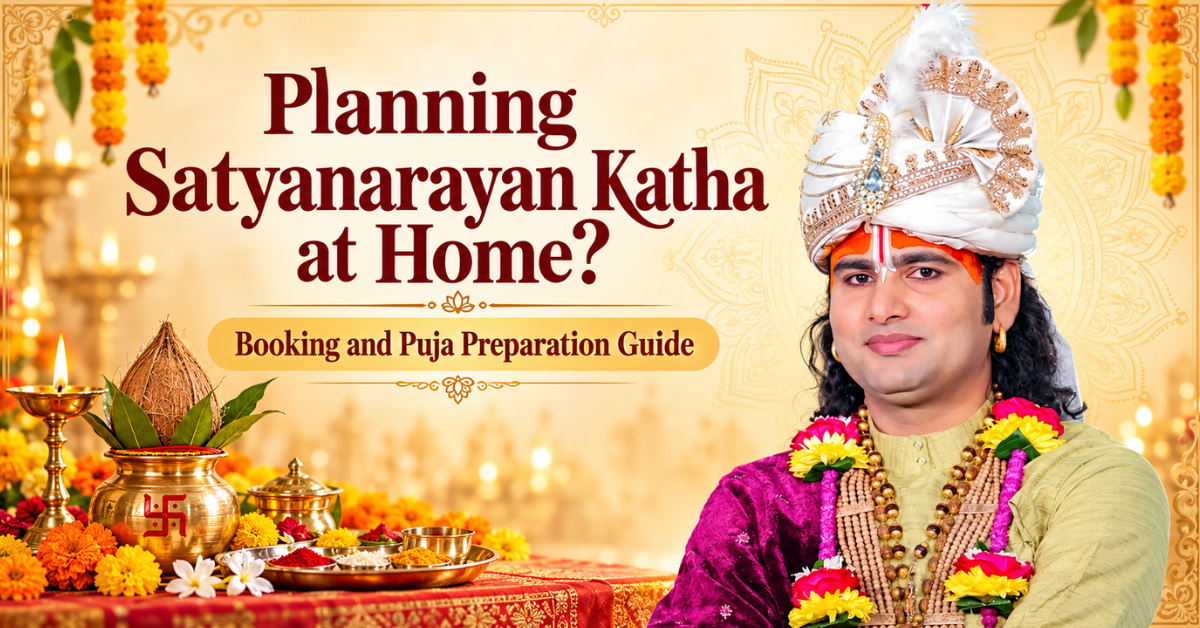
This is the most accessible of the major household pujas, and the easiest to arrange at short notice. Here is everything you need to plan it properly.
What You Are Arranging
Satyanarayan Katha is the worship of Bhagwan Satyanarayan, a benevolent form of Bhagwan Vishnu, combined with the recitation of five short stories from the Skanda Purana. Every one of those stories turns on a single teaching: keep your word, and never treat the Lord's prasad casually.
It is performed for a griha pravesh, a new business, a birth or anniversary, the fulfilment of a sankalp taken in a difficult period, or simply as thanksgiving. Full details are on the Satyanarayan Katha page .
Booking: Four Steps
Send your details. Your city, the occasion, and your preferred date or Purnima tithi.
Confirm the venue. Home, a hired hall or a mandir — most are at home.
Fix the tithi and timing. Morning or pradosh kaal, settled with the coordination team.
Receive the samagri list. It arrives well ahead, scaled to your gathering.
Choosing the Date
| Occasion | Why it is chosen |
|---|---|
| Purnima | The full-moon tithi, considered the most auspicious |
| Kartik, Vaishakh or Chaitra Purnima | Held in particularly high regard through the year |
| Sankranti | The day the sun changes rashi |
| Ekadashi | Observed by many families for Vishnu worship |
| Griha pravesh day | Performed before the family begins living in a new home |
| Any shubh tithi | For an anniversary, mundan, birth or new venture |
Unlike the longer kathas, this one does not need to wait for a festival window. If your family has taken a sankalp, the right time to fulfil it is the earliest date you can arrange.
Preparing the Space
The puja sthal
Choose a clean room. Set a chowki or low wooden platform with a red or yellow cloth, and place a Satyanarayan or Vishnu murti or framed picture on it. The chowki should face the seating, with room in front for the yajman couple to sit.
Seating
Floor seating for family and invited guests, facing the puja sthal. Keep two chairs at the side for elderly relatives. A home puja does not need many guests — family alone is entirely correct.
Before the day
Clean the room thoroughly, arrange fresh flowers, and keep the samagri sorted and within reach of the puja sthal so nothing has to be fetched mid-vidhi.
The Complete Puja Vidhi
Knowing the sequence helps you spot whether it is being done properly:
Preparation of the chowki and sthapana
Sankalp — the yajman states his name, gotra and the specific purpose
Ganesh puja — performed first, as with every Hindu ritual
Navagraha puja — invoking the nine planets
Kalash sthapana — the sacred pot with water, mango leaves and coconut
Sthapana of Bhagwan Satyanarayan, followed by panchamrit snan and offerings
The katha — all five adhyayas recited and explained in sequence
Aarti — the whole family and all guests standing together
Prasad distribution — to every person present, without exception
Bhojan — the meal that follows
The Five Adhyayas
| Adhyaya | The story | The lesson |
|---|---|---|
| First | Narad Ji's question, and the poor Brahmin of Kashi | The vrat is open to everyone, whatever their means |
| Second | The woodcutter who performs the puja himself | Sincere observance changes a life, regardless of station |
| Third | King Ulkamukh, and the merchant Sadhu's vow | A promise made must be honoured, not postponed |
| Fourth | Sadhu's imprisonment; Kalavati's vanishing boat | Forgetting the vow brings loss; remembering restores it |
| Fifth | King Tungadhwaja, who ignored the cowherds' prasad | Prasad must never be refused or treated lightly |
The fourth and fifth are the ones every host family should listen to carefully. Together they make the same point twice: the katha is not complete until the prasad has been distributed and taken by everyone present.
Samagri List
For the puja: a Satyanarayan or Vishnu murti or framed picture, a chowki with red or yellow cloth, kalash with water and coconut, mango leaves, roli, chandan, akshat, moli, haldi, supari and betel leaves, gangajal, tulsi dal, flowers and a garland, incense and dhoop, ghee and cotton wicks for the deep, panchamrit ingredients, fruits including banana, and a Satyanarayan Vrat Katha pothi.
For the prasad (sinni or panjiri): wheat flour or sooji, sugar or gud, ghee, banana and dry fruits. Tradition asks for a sava — one and a quarter — measure of each ingredient.
Niyam for the Family
- Keep a fast from morning until the puja is complete, broken only after taking prasad
- Bathe and wear clean, preferably fresh clothes before the puja begins
- Keep a sattvic vegetarian kitchen that day — no onion, garlic, alcohol or tamasic food
- Husband and wife sit together for the sankalp wherever possible
- Remain seated through all five adhyayas; the family should not leave midway
- Distribute and take the prasad without fail
- Invite family, neighbours and friends, and feed those who come
Choosing the Right Vachak
He performs the full vidhi — sankalp, Ganesh puja, navagraha, kalash sthapana, sthapana, and only then the katha.
He recites all five adhyayas. Shortening to two or three defeats the purpose.
He explains rather than only recites. The stories work only if the family understands what Sadhu's forgotten promise and Tungadhwaja's refused prasad actually mean.
He takes the sankalp properly, using your name, gotra and the specific reason for the puja.
He does not rush the prasad. The katha is incomplete until it has reached everyone present.
What It Costs
There is no price list. The family arranges local transport, sattvic hospitality for the vachak and team, the samagri and prasad, and offers dakshina as per tradition and capacity.
Being a single-sitting household puja, this is by far the most affordable of the major kathas to arrange, which is why many families perform it annually or on every Purnima.
Going Further Later
Families who host this puja regularly often move on to a longer programme. A seven-day saptah for the wider community, or a full Ramcharitmanas narration across the seven kands, are the usual next steps. Pujya Shri Aniruddhacharya Ji Maharaj conducts all of these alongside the ashram's ongoing seva in Vrindavan.
Frequently Asked Questions
How long does a Satyanarayan Katha at home take?
Two to three hours in a single sitting, covering the sankalp, the full puja vidhi, all five adhyayas, aarti and prasad distribution. Adding a havan extends it somewhat.
How far in advance should I book?
Two to four weeks is comfortable for most home pujas. Purnima dates, Diwali week and long weekends need six to eight weeks.
Which day is best for Satyanarayan Katha?
Purnima is considered the most auspicious, along with Sankranti and Ekadashi. It may, however, be performed on any shubh day chosen for your occasion, including a griha pravesh date.
Why is the prasad so important in this katha?
Two of the five adhyayas turn on it. Tungadhwaja lost his kingdom for ignoring the cowherds' prasad, and Kalavati's family suffered until she returned to take it. The katha is not complete until prasad is shared.
Who can perform the Satyanarayan vrat?
Anyone. The origin story makes this its defining feature — the first person shown performing it is a poor Brahmin, the second a woodcutter. No condition of wealth, caste or learning applies.
Do I need a large gathering?
No. A home puja with only the family present is entirely correct. Guests are welcome but not necessary, and many families perform it in an apartment living room with a handful of relatives.
What is a sava measure for the prasad?
One and a quarter of whatever unit you are using — a traditional proportion applied to the flour, sugar, ghee and other sinni ingredients rather than an exact weight.
Share this post:
Continue Your Spiritual Journey
Explore related kathas and pujas for devotion, family occasions, and deeper spiritual practice.
Table of Contents
- Planning Satyanarayan Katha at Home? Booking and Puja Preparation Guide
- What You Are Arranging
- Booking: Four Steps
- Choosing the Date
- Preparing the Space
- The puja sthal
- Seating
- Before the day
- The Complete Puja Vidhi
- The Five Adhyayas
- Samagri List
- Niyam for the Family
- Choosing the Right Vachak
- What It Costs
- Going Further Later
- Frequently Asked Questions
- How long does a Satyanarayan Katha at home take?
- How far in advance should I book?
- Which day is best for Satyanarayan Katha?
- Why is the prasad so important in this katha?
- Who can perform the Satyanarayan vrat?
- Do I need a large gathering?
- What is a sava measure for the prasad?