Hanuman Katha: The Divine Story of Lord Hanuman, Its Meaning and Why Devotees Love to Listen to It
Few figures in Indian spiritual life are as loved as Lord Hanuman. He is the son of Vayu, the servant of Shri Ram, the remover of fear and the symbol of strength joined with humility. Millions of families begin their Tuesdays and Saturdays by remembering him, and millions more sit together in halls, temples and courtyards to hear his story. That story is called Hanuman katha , and it remains one of the most popular forms of devotional listening in India and among the Indian community abroad.
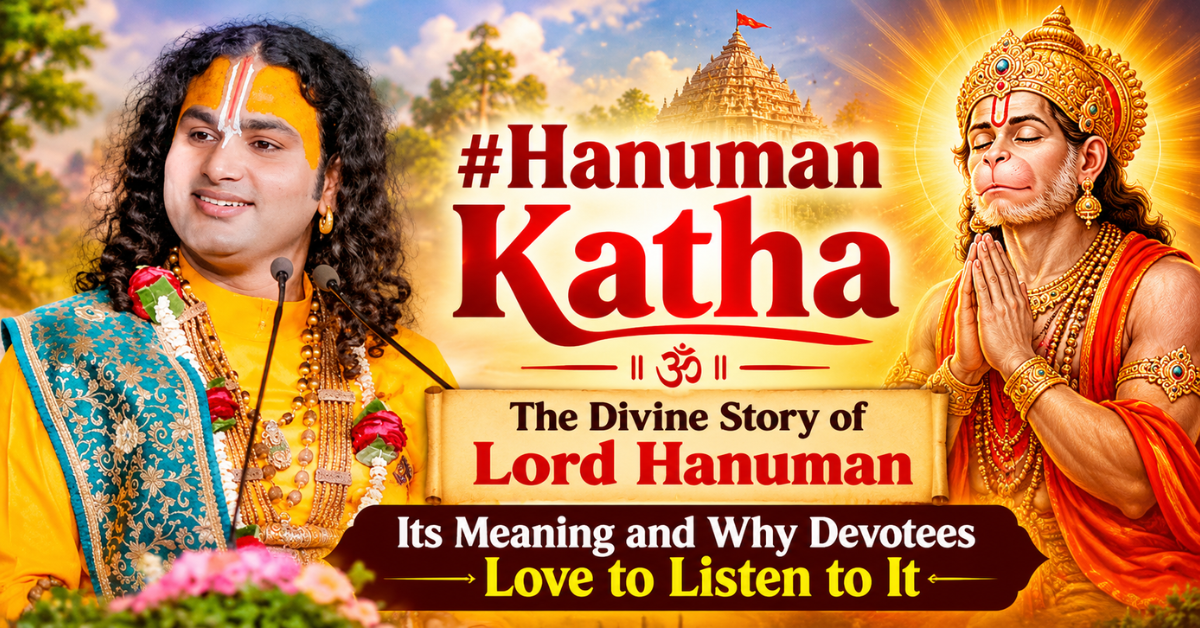
In this article we explain what Hanuman katha is, walk through its most important episodes, share the lessons it teaches and describe why it matters to hear it from a trained katha vachak. If you are planning a katha at home or in your community, you can also explore the dedicated Hanuman katha vachak page on our website.
What Is Hanuman Katha?
The word katha simply means a narrated story, but in the Sanatan tradition it means much more. A katha is a spiritual event in which a learned speaker, called a katha vachak, recites the scripture, explains its meaning, sings bhajans and connects the ancient story with the problems of everyday life. Listeners do not only hear events. They are invited to feel devotion and to change something within themselves.
Hanuman katha draws mainly on the Valmiki Ramayana, the Ramcharitmanas of Goswami Tulsidas and the Hanuman Chalisa. Some tellings also include the Sundar Kand in full, the one book of the Ramayana in which Hanuman is the hero from beginning to end.
The Birth and Childhood of Hanuman
According to tradition, Hanuman was born to Anjana and Kesari, and he is also called Pavanputra because the wind god Vayu had a special role in his birth. From the very beginning he was extraordinary. The most loved childhood story tells how the young Hanuman saw the rising sun, mistook it for a ripe fruit and leapt into the sky to catch it. Indra struck him with his thunderbolt, and the blow left a mark on his jaw. This is why he is called Hanuman, a name connected with the word for jaw.
Vayu was grieved and withdrew the winds, and the whole world began to suffocate. The gods then blessed the child with boons so that no weapon could easily harm him. The story teaches that even great power needs guidance, and that real strength becomes useful only when it is placed in the service of dharma.
Hanuman Meets Shri Ram
The turning point in his life comes in the forest of Kishkindha. Sugriv, in exile and living in fear of his brother Vali, sees two warriors approaching and sends Hanuman to find out who they are. Hanuman disguises himself as a humble Brahmin and speaks with such wisdom that Ram turns to Lakshman and praises his speech. Once Hanuman recognises Ram as the Lord himself, he falls at his feet, and from that moment his whole life belongs to Ram.
This meeting is one of the most moving parts of any Hanuman katha. Hanuman does not ask for kingdoms or powers. He asks only to serve. That attitude of seva, service without expectation, is the heart of his character.
The Leap to Lanka and the Sundar Kand
When Sita is carried away by Ravan, the vanar army searches in every direction. At the southern shore, the searchers stand helpless before the ocean, until the elder Jambavan reminds Hanuman of his own forgotten strength. Hanuman grows vast, bows to Ram, and leaps across the sea. On the way he is tested by Surasa and Simhika, and he passes every test with intelligence and courage.
In Lanka he finds Sita in the Ashok Vatika, gives her Ram's ring and offers her comfort and hope. He then allows himself to be captured so that he can see Ravan's court. When Ravan orders his tail to be set on fire, the burning tail becomes the means by which Lanka itself is set alight. He returns to Ram with the news that Sita is alive, and the whole army rejoices. This long and beautiful episode is the Sundar Kand, which many families recite in full during difficult times.
Sanjeevani and the Battle of Lanka
During the war, Lakshman falls unconscious after being struck by Ravan's son Meghnad. The physician Sushena says only the Sanjeevani herb from the Himalayas can save him, and it must be brought before dawn. Hanuman flies north, cannot identify the herb in the dark and lifts the entire mountain. He returns in time, and Lakshman is revived.
Later, when Ram is crowned king in Ayodhya, Hanuman asks for nothing but a place at his feet. Tradition holds that he is a chiranjivi, one who lives on through the ages wherever Ram's name is spoken. That is why devotees believe Hanuman is present at every Ram katha. To explore this connection further, you can read about the tradition of Ram katha vachak on our website.
Life Lessons from Hanuman Katha
A good katha does not stop at the story. It draws out practical lessons that listeners can use. Some of the most important lessons from Hanuman katha are:
- Humility with strength. Hanuman could lift a mountain, yet he always credits Ram for his deeds. Real greatness does not need to announce itself.
- Courage in the face of fear. Crossing an ocean alone is only possible when faith is stronger than doubt.
- Intelligence and presence of mind. He chooses his words carefully with Ram, with Sita, with Ravan and even with Surasa.
- Loyalty and seva. Hanuman serves without any desire for reward, and his service becomes his glory.
- Self-belief. Jambavan reminds Hanuman who he is. Every person sometimes needs someone who reminds them of their hidden strength.
Benefits of Listening to Hanuman Katha
Devotees believe that hearing Hanuman katha with a sincere heart brings courage, protection and peace of mind. Many people describe a feeling of lightness after attending a katha, as if their worries have been placed at Hanuman's feet. In households, a katha also becomes a shared family event in which grandparents, parents and children sit together and hear values that no screen can teach.
Hanuman katha is commonly organised on Tuesdays and Saturdays, which are dedicated to him, on Hanuman Jayanti, during Navratri and Ram Navami, and on personal occasions such as a new home, a new business or a family milestone. There is no strict rule. What matters is a calm mind, respectful attention and a sincere wish to learn.
Why Listen to Hanuman Katha from an Experienced Katha Vachak
Anyone can read the Ramayana, but a vachak with deep knowledge brings the text alive. A trained katha vachak knows the original verses, understands their different interpretations, selects the right bhajans and explains difficult ideas in simple language. The speaker also senses the mood of the audience and adjusts the pace, so that children and elders both stay engaged.
This is the reason many families look for a trusted katha vachak and a well organised programme. At Aniruddhacharya Ji Maharaj's website , you can learn about the style of katha, the teachings shared and how to connect with the team. The Hanuman katha page is a good starting point if you are looking for information about arranging a Hanuman katha or want to understand what to expect.
How to Organise or Attend a Hanuman Katha
If you plan to host a katha, begin by choosing a suitable date and venue. A clean hall or a decorated courtyard with a picture or murti of Hanuman at the centre is enough. Arrange seating, sound and light, and inform relatives and neighbours well in advance.
If you are attending as a listener, arrive a little early, switch off your phone and sit quietly. Listen not only with your ears but with your attention. Even a single line that touches your heart can stay with you for years. Families who also wish to understand other forms of katha may like to read about Satyanarayan katha , which is commonly organised for peace and prosperity in the home.
Conclusion
Hanuman katha is more than a story of a mighty warrior. It is a story of devotion, humility and quiet strength, told in a way that helps ordinary people face ordinary problems with extraordinary faith. Whether you hear it at a temple, at home or in a large gathering, let it remind you that service done with a pure heart never goes unnoticed.
If you wish to learn more or plan a katha, visit the Hanuman katha vachak page, and may the blessings of Shri Hanuman and Shri Ram remain with you and your family. Jai Shri Ram, Jai Hanuman.
Share this post:
Continue Your Spiritual Journey
Explore related kathas and pujas for devotion, family occasions, and deeper spiritual practice.
Table of Contents
- Hanuman Katha: The Divine Story of Lord Hanuman, Its Meaning and Why Devotees Love to Listen to It
- What Is Hanuman Katha?
- The Birth and Childhood of Hanuman
- Hanuman Meets Shri Ram
- The Leap to Lanka and the Sundar Kand
- Sanjeevani and the Battle of Lanka
- Life Lessons from Hanuman Katha
- Benefits of Listening to Hanuman Katha
- Why Listen to Hanuman Katha from an Experienced Katha Vachak
- How to Organise or Attend a Hanuman Katha
- Conclusion