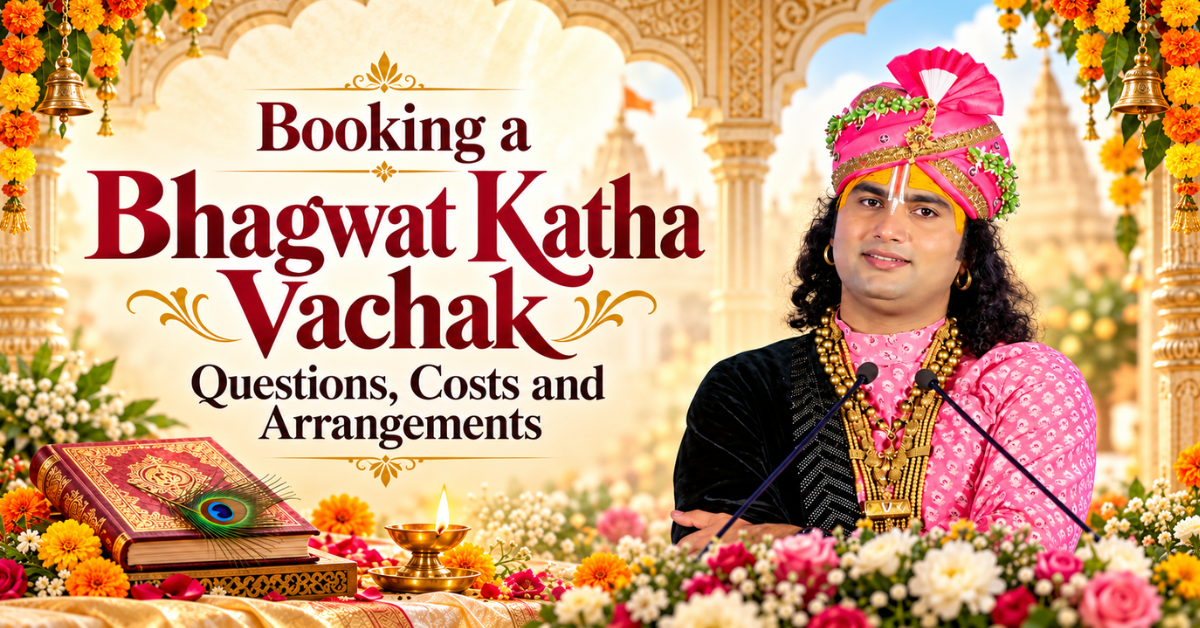
Booking a Bhagwat Katha Vachak: Questions, Costs and Arrangements
Booking a Bhagwat Katha vachak comes down to three things: asking the right questions before you confirm, understanding what you are actually paying for, and being clear from the first conversation about which side arranges what. Get those three settled and the rest of the programme runs smoothly.
Most families get this wrong in the same way — they fix a date on a recommendation, then discover six weeks later that nobody agreed who was arranging the sound system or the samagri. This guide prevents that.
Start by Understanding What You Are Booking
A Bhagwat Katha is the ceremonial narration of the Shrimad Bhagavata Purana — twelve skandhas, traditionally narrated across seven days as a saptah, running in a fixed order from King Parikshit through Krishna's janm and leelas to Sudama charitra and the closing havan.
The vachak is doing three jobs at once: reciting from the scripture, explaining it to an audience of mixed backgrounds, and performing the ritual sequence that frames it. That is why the questions below matter more than they might seem. Formats and durations are set out on the Bhagwat Katha service page .
The Questions to Ask Before You Confirm
On training and command of the text
Which guru parampara did you train in? A genuine vachak names his teacher and lineage without hesitation.
Which skandha does a particular prasang belong to? Ask about any episode you know. Real study answers instantly; a memorised repertoire does not.
On the structure of the programme
What exactly will be covered on each day? You should receive a day-by-day outline before you confirm. The most common shortcut in this field is to open with Krishna janm and Maharaas because they draw the strongest response, then fill the remaining days loosely.
Will the narration follow the skandhas in sequence? It should.
On the ritual side
Does your team perform the puja vidhi, or do we arrange a pandit separately? This single question prevents the most common last-minute scramble.
Is the kalash yatra and the closing havan with purnahuti included?
On logistics
Will the same vachak be present for every day? Substitutions midway through a saptah are more common than families expect, and they break the continuity that makes a katha work. Get this confirmed.
What are the travel and accommodation requirements for you and your team?
When will we receive the samagri list?
Can we speak to a family who hosted your katha previously? The most useful question on the list, and the one most people skip.
What a Bhagwat Katha Actually Costs
There is no price list. Katha is offered as a spiritual seva, so no fixed fee exists — but there are real costs, and a host family should budget for them openly.
| Cost head | Typically arranged by | Notes |
|---|---|---|
| International and local travel | Host | For overseas programmes this is usually the largest single item |
| Accommodation and sattvic meals | Host | For the vachak and accompanying team |
| Venue hire | Host | Not applicable for home kathas |
| Stage, vyas peeth, backdrop | Host | Scaled to the venue |
| Sound and lighting | Host | A tested PA system with a lapel mic |
| Puja samagri | Host | From the list shared in advance |
| Daily prasad | Host | Through all days of the saptah |
| Closing bhandara | Host | Where planned |
| Dakshina | Offered by the yajman | As per tradition and capacity |
How host families actually manage it
For community programmes, costs are almost always shared. Temple committees, satsang mandals and groups of sponsor families come together to host one saptah for the whole sangat, which keeps it affordable for everyone and usually produces a better-attended programme than a single family can manage alone.
If a full seven-day saptah is beyond what your group can take on right now, a single-session programme is a complete observance in itself and a sensible way to learn how your volunteers handle an event.
Arrangements: Who Does What
What the vachak's side provides
Narration for the agreed number of days, the vyas peeth puja and daily ritual sequence performed by the accompanying team, bhajan and kirtan support, guidance on the samagri list and kalash yatra route, coordination on daily timings and the concluding havan, and pre-programme calls with your organising committee.
What the host family provides
The venue with any permissions required, the stage and vyas peeth, tested sound, puja samagri, travel and sattvic accommodation, daily prasad and the closing bhandara, and a volunteer team for registration, seating, prasad and cleanliness.
What the yajman family observes
Take the sankalp on day one before the vyas peeth puja and remain present for all sessions. Keep a sattvic vegetarian kitchen for the full duration — no onion, garlic, alcohol or tamasic food. Keep the akhand deep lit where the tradition is followed. Bathe and wear clean clothes before each session. Sit through each day to its aarti. Serve the sangat with humility.
Be honest about this before you commit. Seven days of attendance is a real demand on a working family.
Choosing the Right Duration
| Format | Who it suits |
|---|---|
| 1-day katha | Home puja, barsi, small family milestone |
| 3-day katha | Weekend community programme |
| 5-day katha | Mid-size temple or association event |
| 7-day saptah | The traditional and most complete format |
| 9-day katha | Large festival or trust-hosted mahotsav |
Volunteer strength, not budget, is usually the deciding factor. A three-day katha hosted well serves a family far better than a seven-day one hosted thinly.
Timeline: When to Start
Four to eight weeks of notice is comfortable for most dates. Janmashtami, Diwali, Purushottam Maas and school-holiday weekends need three to six months, because those windows are reserved first.
Overseas tours are planned as multi-city routes rather than single visits, so early enquiry also improves the chance your city fits the itinerary. Fix the venue and the vachak together — a confirmed narrator with no hall is as useless as the reverse.
Before You Make the Call
Have these ready and the first conversation will settle almost everything: your city, two or three possible date windows, the duration you are considering, your venue type and expected attendance, and whether your committee or a single family is hosting.
You can send all of this through the enquiry form in one go. Pujya Shri Aniruddhacharya Ji Maharaj conducts Bhagwat Katha alongside the ashram's seva work in Vrindavan, and also narrates the seven kands of the Ramcharitmanas for committees that prefer a Ram Katha.
Frequently Asked Questions
How much does it cost to book a Bhagwat Katha vachak?
There is no fixed fee, since katha is offered as seva. Hosts budget for travel, accommodation, venue, samagri, sound, prasad and bhandara, plus the dakshina offered as per tradition and capacity.
How far in advance should a Bhagwat Katha be booked?
Four to eight weeks for most dates. Festival windows such as Janmashtami, Diwali and Purushottam Maas need three to six months of notice.
Does the vachak bring his own team for the puja?
Often yes, but confirm it at the time of booking. If the team does not include a pandit, the host must arrange one separately for the puja vidhi.
Can several families share the cost of one katha?
Yes, and most overseas programmes work this way. Temple committees and groups of sponsor families commonly host one saptah together for the whole community.
What happens if we cannot commit to seven days?
Choose a shorter format. One-day, three-day and five-day kathas are all valid observances that keep the essential prasangs and the closing yagya intact.
Who arranges the samagri?
The host family arranges it, from a list shared well before the programme and scaled to the venue and expected attendance.
Share this post:
Continue Your Spiritual Journey
Explore related kathas and pujas for devotion, family occasions, and deeper spiritual practice.
Table of Contents
- Booking a Bhagwat Katha Vachak: Questions, Costs and Arrangements
- Start by Understanding What You Are Booking
- The Questions to Ask Before You Confirm
- On training and command of the text
- On the structure of the programme
- On the ritual side
- On logistics
- What a Bhagwat Katha Actually Costs
- How host families actually manage it
- Arrangements: Who Does What
- What the vachak's side provides
- What the host family provides
- What the yajman family observes
- Choosing the Right Duration
- Timeline: When to Start
- Before You Make the Call
- Frequently Asked Questions
- How much does it cost to book a Bhagwat Katha vachak?
- How far in advance should a Bhagwat Katha be booked?
- Does the vachak bring his own team for the puja?
- Can several families share the cost of one katha?
- What happens if we cannot commit to seven days?
- Who arranges the samagri?