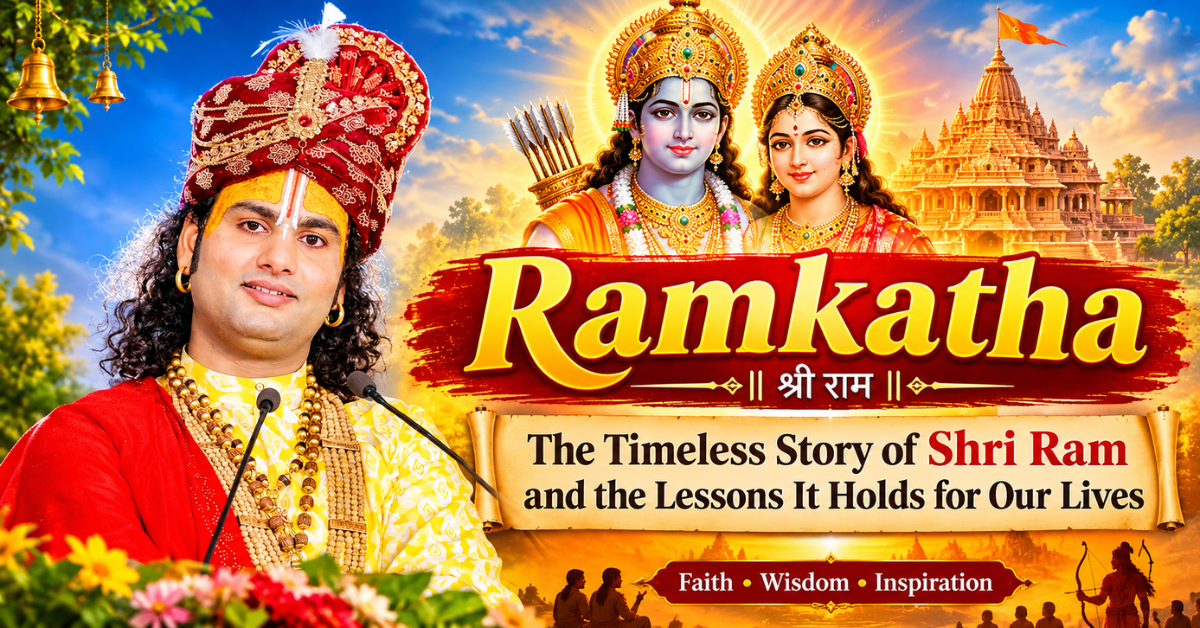
Ramkatha: The Timeless Story of Shri Ram and the Lessons It Holds for Our Lives
There are stories that are told once and forgotten, and there are stories that are told for thousands of years and still feel new. Ramkatha belongs to the second kind. It is the story of Shri Ram, the prince of Ayodhya who became the ideal of dharma, and of Sita, Lakshman, Bharat and Hanuman, whose love and loyalty have shaped Indian character for generations. From village courtyards to large pavilions, the Ramkatha continues to gather people together.
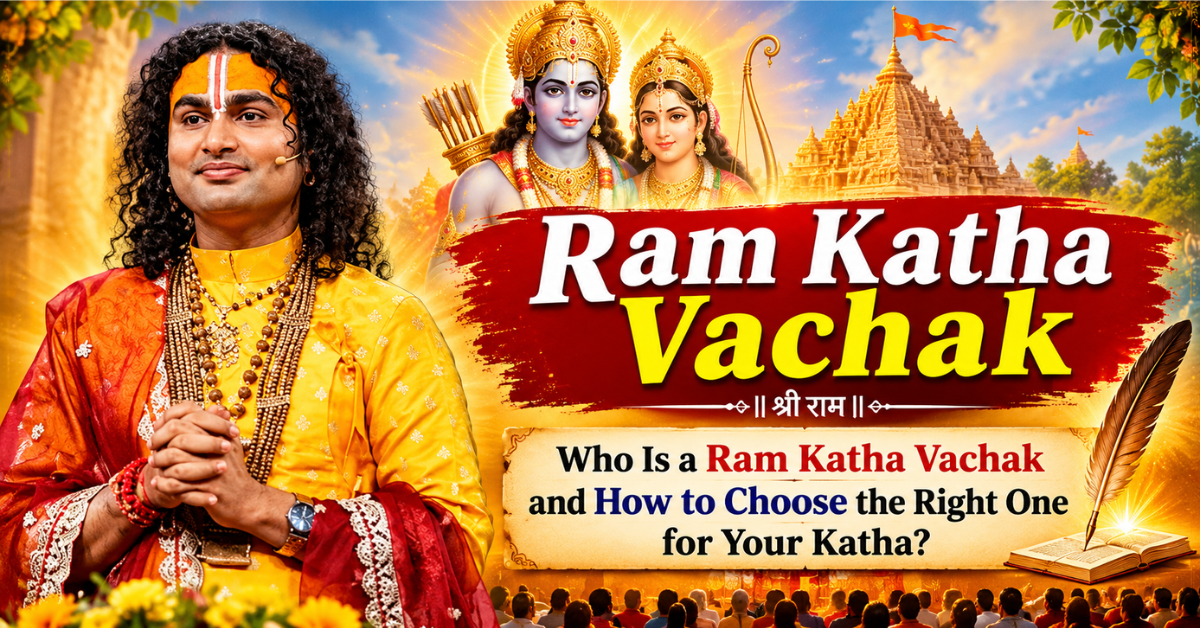
This article offers a clear and simple overview of Ramkatha: what it is, the scriptures behind it, the main episodes, the lessons it teaches and the best way to listen to it. If you would like to hear it from an experienced speaker, the Ram katha vachak page on our website will help you get started.
What Is Ramkatha?
Ramkatha is the narration of the life of Shri Ram. The word combines Ram, the Lord, and katha, a narrated story. In a broader sense, it describes not only the epic itself but also the whole tradition of telling and explaining it. When people say they are going to Ramkatha, they usually mean a gathering in which a speaker recites verses from the Ramayana or the Ramcharitmanas, explains their meaning and sings devotional songs.
The story has a special place because it presents an ideal. Ram is described as maryada purushottam, the best among those who follow limits. He is a loving son, a faithful husband, a caring brother, a loyal friend and a just king. The epic asks a simple but powerful question: how should a person live when duty, love and difficulty all pull in different directions?
The Scriptures Behind Ramkatha
The oldest and most respected source is the Valmiki Ramayana, written in Sanskrit and traditionally divided into seven kands or books: Bal Kand, Ayodhya Kand, Aranya Kand, Kishkindha Kand, Sundar Kand, Yuddha Kand and Uttar Kand. Each book covers a stage in the journey of Ram, from his childhood to his reign.
The second great source for many Hindi speaking households is the Ramcharitmanas by Goswami Tulsidas, written in Awadhi in the sixteenth century. Its verses, called doha and chaupai, are sung in temples and homes, and a large number of people know some of them by heart. Besides these two, there are many other tellings in regional languages and traditions, each with its own beauty. Despite small differences, they all share the same spirit of devotion.
The Main Episodes of Ramkatha
Birth and childhood. King Dasharath of Ayodhya, longing for a child, performs a yagya and is blessed with four sons: Ram, Bharat, Lakshman and Shatrughan. The boys grow up with love and discipline, and Sage Vishwamitra takes Ram and Lakshman to protect his sacrifice from demons.
The marriage of Ram and Sita. At Janakpur, Ram lifts and breaks the great bow of Shiv, and he is married to Sita, daughter of King Janak. The wedding is celebrated as an ideal of pure and respectful love.
The exile. On the eve of Ram's coronation, Queen Kaikeyi asks for two boons: Bharat's coronation and fourteen years of exile for Ram. Ram accepts without bitterness, and Sita and Lakshman choose to accompany him. Dasharath dies of grief, and Bharat refuses the throne, placing Ram's sandals upon it as a symbol of his brother's rule.
Sita's abduction. In the forest of Panchavati, Ravan carries Sita away to Lanka. Jatayu, the old vulture, tries to stop him and gives his life. Ram and Lakshman search for her and meet Shabari, who offers them fruits with deep love.
Friendship with Sugriv and Hanuman. Ram helps Sugriv regain his kingdom, and in return the vanar army joins the search. Hanuman crosses the ocean, finds Sita and burns Lanka.
The war and the return. A bridge is built across the sea, and the battle with Ravan ends with the victory of truth over arrogance. Ram returns to Ayodhya after fourteen years, and the city celebrates with lamps. This homecoming is remembered each year at Diwali.
To read more about the devoted servant who stands at the centre of the middle chapters, you can visit our page on Hanuman katha .
Core Themes of Ramkatha
Ramkatha is a rich epic, and listeners find different meanings in it at different stages of life. Still, a few themes appear again and again.
- Dharma and duty. Every major character is tested between personal desire and duty, and the story honours those who choose duty with a pure heart.
- Relationships. The epic shows ideal relations between father and son, brother and brother, husband and wife, king and subjects, and master and servant.
- Sacrifice. Ram gives up a throne, Lakshman gives up comfort, Bharat gives up power and Sita gives up the palace. Their sacrifices are remembered more than any victory.
- Devotion. Hanuman, Shabari, Kevat and Vibhishan show that sincere love matters more than status or learning.
- Victory of truth. Ravan was powerful and learned, yet his arrogance and injustice destroyed him.
Ramkatha in Daily Life
The beauty of Ramkatha is that it does not remain in the temple. It enters everyday decisions. A person who is troubled by a family disagreement can remember Bharat's love for his brother. A person who faces a hard promise can recall how Ram kept his father's word. A person who must lead a team can learn from Ram's respect for even the smallest member of his army.
Many families recite a few lines from the Ramcharitmanas each morning or evening, and some read a short portion every day throughout the month of Sawan or Kartik. Others observe Ram Navami by organising a full katha with bhajans and community meals. Each of these customs keeps the story alive in a personal way.
How to Listen to Ramkatha with Understanding
Listening is a skill, and a few simple habits make it more rewarding.
- Come with a calm mind. Arrive early, sit comfortably and leave other worries outside the hall for a while.
- Listen to the meaning, not only the melody. Bhajans are beautiful, but the explanation of the verses carries the lesson.
- Carry one thought home. Pick one idea from each session and try to apply it that day.
- Involve your family. Children learn values best when they see elders giving time to something sacred.
- Reflect afterwards. A few quiet minutes of thinking after the katha helps the message settle.
A skilled katha vachak makes this process easier by organising the story into clear segments, explaining difficult words and connecting the message with modern life. You can learn more about the teaching style of Aniruddhacharya Ji Maharaj on the official website.
Ramkatha and Other Katha Traditions
Ramkatha is only one of the many katha traditions in Sanatan culture. Families often combine it with other occasions of listening and worship. For example, the Bhagwat katha tells of Krishna, and the Satyanarayan katha is performed at home for peace, gratitude and prosperity. If you wish to understand the second tradition, read our introduction to Satyanarayan katha . Each katha has its own method and mood, yet all of them guide listeners towards the same goals of truth, humility and devotion.
Conclusion
Ramkatha is a story, a scripture, a tradition and a way of life. It reminds us that a person can face loss, exile and betrayal and still choose truth, patience and love. It shows that strength lies not in force but in character, and that a home becomes a temple when its members respect one another.
If you wish to experience Ramkatha in a meaningful way, visit the Ram katha vachak page and learn more about the programmes and teachings shared there. May the story of Shri Ram guide your steps and bring peace to your family. Jai Shri Ram.
Share this post:
Continue Your Spiritual Journey
Explore related kathas and pujas for devotion, family occasions, and deeper spiritual practice.