

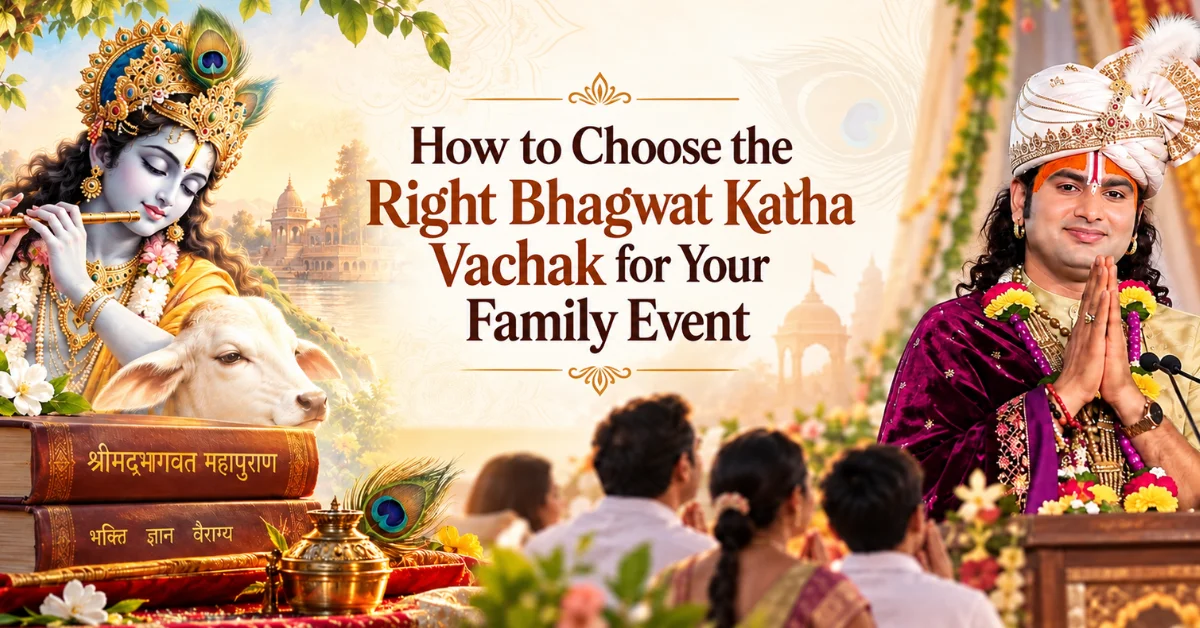
How to Choose the Right Bhagwat Katha Vachak for Your Family Event
Deciding to host a Bhagwat Katha is the easy part. The harder question comes next: who will narrate it? A seven-day Bhagwat Saptah is a serious commitment of time, money and shraddha, and the vachak you invite will shape whether your family remembers it as a genuine spiritual experience or as an event that simply happened.
Most families choose a vachak on a recommendation and nothing more. That works sometimes. But if you know what to look for, you can make a far better decision — and this guide walks you through exactly that.
First, Understand What You Are Actually Booking
A Bhagwat Katha is the ceremonial narration of the Shrimad Bhagavata Purana, traditionally spread across seven days as a Bhagwat Saptah. The vachak sits on the vyas peeth and recites, sings and explains the twelve skandhas in sequence, from the story of King Parikshit through Krishna's janm and leelas to Sudama charitra and the closing havan.
This matters for your selection, because it tells you what skill set you need. A Bhagwat Katha vachak is not a motivational speaker with religious content. He is a scriptural narrator, a ritual performer and a teacher, all at once — and a weak link in any of those three shows up quickly over seven days. If you are still deciding on format and duration, the full breakdown of what a saptah involves is on the Bhagwat Katha page .
Seven Things to Check Before You Book a Bhagwat Katha Vachak
1. Scriptural grounding, not just delivery
Ask which skandha a particular prasang comes from. A trained vachak answers immediately, because he has studied the text under a guru parampara rather than learning a set of popular stories. Fluency is easy to fake for an hour. Over seven days, scriptural grounding either exists or it does not.
2. He narrates in sequence
Some speakers jump straight to Krishna janm and Maharaas on day one because those draw the biggest response, then fill the remaining days loosely. A proper Bhagwat Katha follows the twelve skandhas in order. If a vachak cannot tell you in advance what will be covered on each day, that is a warning sign.
3. Correct vidhi, performed fully
The kalash yatra, vyas peeth puja, daily aarti sequence and the concluding havan with purnahuti are part of the katha, not optional extras. Ask specifically what ritual sequence will be followed, who performs it, and whether the team travels with the vachak or whether you are expected to arrange a separate pandit.
4. Bhav over performance
Sit through a recording before you decide — not a highlights reel, a full session. Watch whether the narration moves the sangat towards bhakti or towards applause for the speaker. Both can fill a hall. Only one of them leaves something behind afterwards.
5. Clarity for your actual audience
If your family is settled overseas, or if half the hall will be under thirty, this becomes the deciding factor. The vachak must explain the shastra in a way that a listener with limited Hindi can follow, without diluting it into a generic talk. Ask directly how he handles mixed audiences.
6. A life consistent with the teaching
A katha on detachment and seva carries different weight from someone who practises it. Find out what the vachak does when he is not on the vyas peeth. Does he run or serve an ashram? Is there ongoing gaushala, annakshetra or gurukul work behind his name? Pujya Shri Aniruddhacharya Ji Maharaj, for instance, conducts katha alongside the ongoing seva at Gauri Gopal Ashram in Vrindavan, and that context is verifiable rather than merely claimed.
7. Availability for the full duration
Confirm in writing that the same vachak narrates all seven days. Substitutions midway through a saptah are more common than families expect, and they break the continuity that makes a katha work.
Questions Worth Asking Before You Confirm
- Which skandhas will be covered on each day?
- Does your team perform the puja vidhi, or must we arrange a pandit separately?
- What are the daily timings, and how long is each session?
- What samagri will we need to arrange, and when will we receive the list?
- What are the travel and accommodation requirements for you and your team?
- How is dakshina handled, and what else should we budget for?
- Can we speak to a family who hosted your katha previously?
That last question is the most useful one on the list, and the easiest to skip. Ask it anyway.
Matching the Format to Your Family Event
Not every occasion calls for a full seven-day saptah. A 1-day or 3-day katha works well for a home puja, a barsi or a small family milestone. A 5-day or 7-day programme suits a temple, an association event or a community-wide gathering. Nine-day formats are usually reserved for a large mahotsav.
Be honest about your volunteer capacity before choosing. A seven-day katha needs people for registration, seating, prasad, cleanliness and daily setup. Families who host a shorter katha well are far better served than families who host a long one thinly.
Common Mistakes Families Make
Booking on popularity alone. A large online following tells you someone is a good communicator. It does not tell you how they handle a vyas peeth, or whether they will finish the katha in sequence.
Leaving the samagri to the last week. Overseas especially, several traditional items take time to source. Get the list early.
Not clarifying who arranges what. Venue, stage, sound, travel, accommodation, prasad and bhandara are usually the host's responsibility. Confirm this in the first conversation, not the last.
Choosing a date before checking the hall. Festival weekends fill fast in every city. Fix the venue and the vachak together.
Forgetting the niyam. The yajman family is expected to keep a sattvic diet, take the sankalp on day one and attend every session. Know this before you commit, not after.
If a Full Saptah Feels Too Large Right Now
Many families begin smaller and build up. A single-session Hanuman Katha or Sundarkand path fits into a Tuesday evening. A Satyanarayan puja at home takes an afternoon and needs nothing more than a clean room and the samagri kept ready. A three-day Ram Katha works comfortably over a weekend.
Any of these is a complete observance in itself, and hosting one tells you a great deal about how your family and your volunteers handle a programme — which makes the eventual saptah far easier to organise.
Share this post:
Frequently Asked Questions
Continue Your Spiritual Journey
Explore related kathas and pujas for devotion, family occasions, and deeper spiritual practice.
Table of Contents
- First, Understand What You Are Actually Booking
- Seven Things to Check Before You Book a Bhagwat Katha Vachak
- 1. Scriptural grounding, not just delivery
- 2. He narrates in sequence
- 3. Correct vidhi, performed fully
- 4. Bhav over performance
- 5. Clarity for your actual audience
- 6. A life consistent with the teaching
- 7. Availability for the full duration
- Questions Worth Asking Before You Confirm
- Matching the Format to Your Family Event
- Common Mistakes Families Make
- If a Full Saptah Feels Too Large Right Now
.webp)


