

Hanuman Katha: Significance, Benefits, and How to Book an Experienced Vachak
Of all the kathas a Hindu family can host, Hanuman Katha is the one people turn to when something is difficult. A court matter dragging on. An illness in the house. A child's exams. A business that will not lift. The instinct is old and widely shared: when things are heavy, call on Bajrang Bali.
This guide explains what a Hanuman Katha actually involves, why it is considered so powerful, and what to look for when choosing a vachak.
What Is Hanuman Katha?
Hanuman Katha is the devotional narration of the birth, leelas, strength and unbroken devotion of Shri Hanuman Ji — from his childhood leap towards the sun, through his meeting with Shri Ram at Rishyamukh, the crossing of the ocean, the darshan of Mata Sita in Ashok Vatika, the burning of Lanka, the lifting of the Sanjeevani mountain, and finally his eternal seva at Shri Ram's feet.
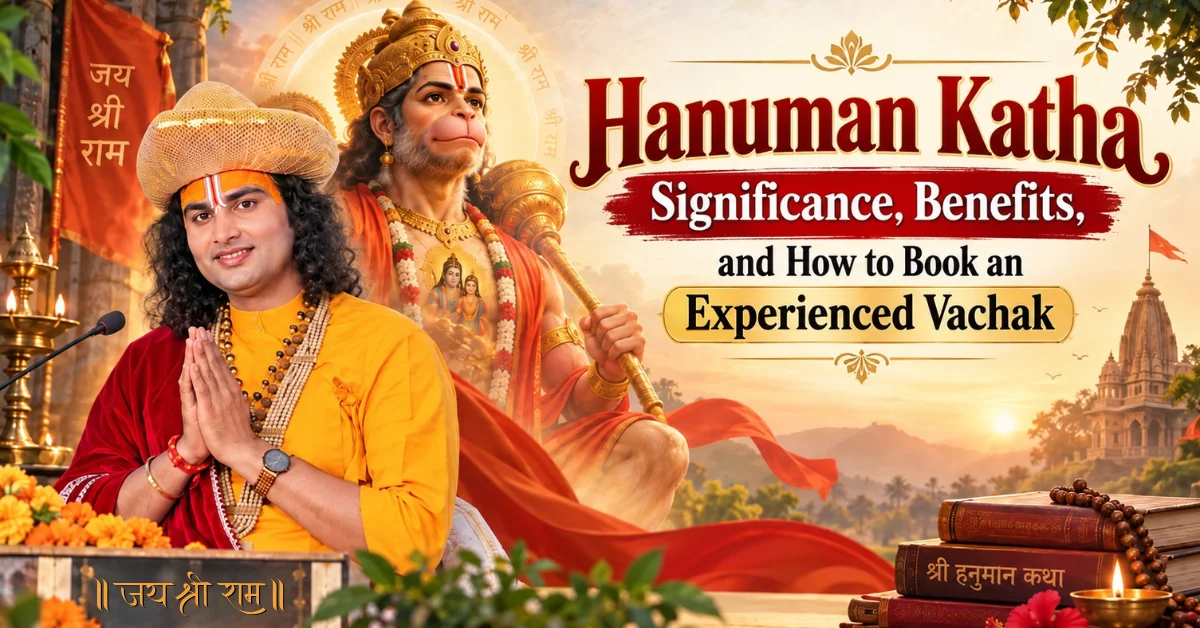
Unlike a seven-day Bhagwat Saptah, a Hanuman Katha is most often held as a single powerful session or a short multi-day programme. That makes it the most practical katha for working families, and it is frequently the first katha a household hosts. Full details on formats and durations are on the Hanuman Katha page .
Why Sundarkand Sits at the Centre of It
Almost every Hanuman Katha includes a Sundarkand path, and for good reason.
Sundarkand is the fifth kand of Goswami Tulsidas's Ramcharitmanas, and it is the only section of the entire epic where Hanuman Ji, not Shri Ram, is the central figure. It is unique in another way too: from beginning to end, it is a chapter of accomplishment. Every task Hanuman Ji undertakes in it succeeds. The ocean is crossed. Mata Sita is found. The message is delivered. Lanka is shaken.
This is why families facing prolonged obstacles are traditionally advised to arrange a Sundarkand path. The reading itself is regarded as an invocation of success, and the collective recitation carries a hall in a way narration alone does not.
Understanding the Three Together
People often use these terms interchangeably. They are related but distinct:
Hanuman Katha is the narrated story of Hanuman Ji's life, explained by a vachak — anywhere from a single session to several days.
Sundarkand path is the recitation of the fifth kand of the Ramcharitmanas, usually two to three hours, often sung collectively.
Hanuman Chalisa is the forty-chaupai composition of Goswami Tulsidas, taking eight to ten minutes, and frequently recited 11, 21 or 108 times as a sankalp.
Most host families combine all three: the katha for the story and its meaning, the Sundarkand path for the scriptural recitation, and the Chalisa at the close with the whole sangat reciting together.
Benefits of Listening to Hanuman Katha
Devotees host or attend a Hanuman Katha for these reasons:
- Courage and relief from fear — Hanuman Ji is invoked above all as the remover of bhay
- Protection of home and family , particularly during illness, travel or an unsettled period
- Removal of obstacles in work, study, business and long-pending matters
- Peace from anxiety and mental unrest , through the discipline of shravan and collective recitation
- Relief associated with Shani and Mangal doshas , as held in traditional practice
- Strength of sankalp at the start of a demanding undertaking
- Sanskar for children , who meet Hanuman Ji as a full character rather than a picture on the wall
Tradition holds that Hanuman Ji is present wherever his katha is narrated with shraddha — which is why even one evening session is considered complete in itself.
When to Host a Hanuman Katha
- Tuesday (Mangalwar) — the day most closely associated with Hanuman Ji
- Saturday (Shanivar) — traditionally observed for relief from Shani-related difficulty
- Hanuman Jayanti — Chaitra Purnima, and Kartik Krishna Chaturdashi in several regions
- Ram Navami and Chaitra Navratri , when Ram Katha and Hanuman Katha are often paired
- Before a new venture , an examination season, a court matter or a family relocation
For families abroad, a Tuesday or Saturday evening usually works better than a weekday morning, and Hanuman Jayanti dates fill earliest.
How to Choose an Experienced Hanuman Katha Vachak
Command of the Ramcharitmanas. He should recite the chaupais accurately and explain the meaning of the lines he sings, not only the story wrapped around them.
The full narrative, in sequence. A trained vachak does not skip from the janm katha straight to Lanka dahan because the dramatic episodes get a bigger reaction.
Correct vidhi. Vyas peeth puja, the chola and sindoor offering, Sundarkand recitation and closing aarti performed in proper order.
He leads the sangat, not just addresses it. In a Hanuman Katha, the collective Chalisa and Sundarkand recitation matter as much as the narration. A vachak who only speaks at people misses half of what the programme is for.
A life consistent with the teaching. Hanuman Katha is a katha about seva. Ask what the vachak does off the vyas peeth — ashram work, gaushala, gurukul, annakshetra.
Clarity for mixed audiences. Especially overseas, the vachak must explain in a way that listeners with limited Hindi can follow.
What You Need to Arrange
For a home or hall programme, the host typically arranges the space and a Hanuman Ji murti or framed picture for the puja, red cloth for the aasan, sindoor and chameli oil for the chola, the standard puja items, a Sundarkand pothi, printed Hanuman Chalisa copies for the sangat, and prasad — usually boondi, besan laddoo, banana and gud-chana.
The niyam are straightforward. Take a sankalp before the puja, keep a sattvic vegetarian kitchen that day without onion or garlic, bathe and wear clean clothes, sit through the session to its aarti, and serve prasad to everyone present. Many yajman families also keep a Tuesday vrat where they are able.
Starting Here, Going Further
Because it fits into an evening, Hanuman Katha is often where a family's katha tradition begins. From there, many households go on to host a full Ram Katha covering all seven kands of the Ramcharitmanas, a seven-day Bhagwat Saptah for the wider community, or a Satyanarayan puja at home for a griha pravesh or family milestone. Each is complete in itself, and one leads naturally to the next.
Share this post:
Frequently Asked Questions
Continue Your Spiritual Journey
Explore related kathas and pujas for devotion, family occasions, and deeper spiritual practice.
.webp)


